
THE CONNECTION BETWEEN HERITAGE, ART, AND YOUTH
Introduction
Nepal has a rich cultural heritage, as a country with diverse traditions and identities, which have been passed down through generations. Its essence and values are a precious resource for the nation. Protecting and promoting this inheritance requires continuous commitment and effort. The rich history and amazing architectural wonders are tapped in the Kathmandu Valley with six remarkable UNESCO World Heritage Sites, among which are the thousands of heritages that are known as the City of Temples. Yet, with the advancement of modernisation, the heritages face growing threats. To honour and protect what we’ve inherited, we must engage those who will inherit it next– our youth. If our generation becomes the bridge between Nepal’s ancient wisdom and future resilience, we could integrate the valley’s identity in craftsmanship, music, and art through digital storytelling and cultural education that ensures these traditions endure and remain relevant. Engaging youth in understanding these through research and community engagement would connect with the wisdom of the past and create a space to foster a resilient Nepali identity that is rooted in their cultural legacy.
The Workshop on Heritage Studies aimed to ignite curiosity and empower leadership among young people aged 18-24, nurturing a new generation of heritage ambassadors through immersive training, hands-on experiences, and stakeholder collaboration.
Objectives
- To organise six workshops, each of fifteen participants, focusing on the knowledge of heritage, relevant bylaws, and building skills in advocacy and research.
- To engage participants in real-world projects that are based on advocacy, documentation, promotion, and preservation.
- To collaborate with like-minded organisations and stakeholders dedicated to heritage work to share expertise and resources.
Context
Where formal education ends, community learning begins.
At present, there are no available short-term programs in Nepal that explore heritage studies in depth. To fill this void, Nepalko Kala planned to introduce a short-term program on “Heritage Education.” This program focused on different facets of culture, traditions, preservation, and rituals, where one gets a holistic insight into heritage.
In 2021, UNESCO undertook a similar initiative in its pilot project, Teaching with Intangible Cultural Heritage (ICH) in Schools in Asia and the Pacific, implemented in Nepal. As part of this project, four public schools in Budhanilkantha and Kirtipur municipalities developed lesson plans integrating intangible cultural heritage in formal education. More than 350 students took part, fostering connections between their existing knowledge and elements of cultural heritage. In addition to these, lately, the school education system has also included local knowledge, traditions, and cultural identity in its curriculum, strengthening the role of heritage in education.
In order to promote heritage education initiatives, there is a need to combine the knowledge of professionals and community resource persons. By filling the divide between experts and eager students, the learning process will not only become richer, but it will also help preserve the heritage in a sustainable way.
Workshop Design
What if a classroom could be a courtyard, a street corner, or a temple?
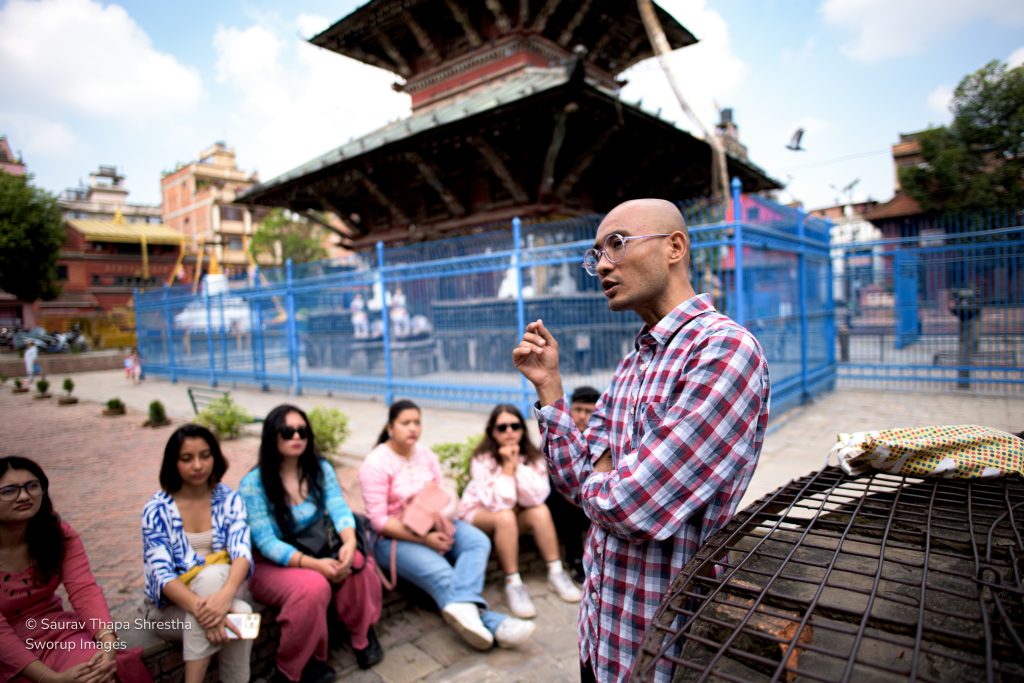
The initial cohort had a 12-hour immersive workshop that was distributed over 6 days and involved 11 participants. This was a pilot workshop, and by the end of 2026, the program is set to have 90 trained youth leaders.
The workshop addressed various themes, which were arranged in different modules. It is set into the following modules.
- Foundations of Heritage
- Legal Framework and Stakeholders
- Deconstructing Nepal’s Heritage
- Heritage, Community and Culture
- Contemporary Contexts and Current Challenges
- Youth in Heritage- Case Studies and Action Plan
The workshop occurred between August 9 and September 27, 2025. Every session entailed a combination of indoor sessions, on-field observations and walks around heritage sites of historical significance.
Following experts across various modules were invited to facilitate the sessions.
- Saurav Thapa Shrestha, Heritage Researcher
- Sanjay Adhikari, Heritage Law Practitioner
- Anil Chitrakar, Philanthropist
- Rishi Amatya, Heritage Interpretator
- Alok Siddhi Tuladhar, Activist
- Binita Magaiya, Heritage Researcher
